
Cambodia continues to position itself as a premier destination for investment in Southeast Asia. As of 2026, the government has balanced its need for revenue with a competitive “pro-growth” strategy, particularly through the Law on Investment (LoI) and updated regulations on Capital Gains Tax (CGT).
The Power of Tax Holidays
For most investors, the centerpiece of the Cambodian tax system remains the Qualified Investment Project (QIP) status. Managed by the Council for the Development of Cambodia (CDC), QIPs can secure an “Income Tax Holiday” lasting between 3 and 9 years.
What makes this incentive unique in 2026 is the “soft landing” period that follows. Once the holiday expires, companies don’t jump immediately to the standard 20% Corporate Income Tax (CIT). Instead, they pay a progressive rate—starting at just 25% of the total tax due for the first two years—allowing businesses to scale sustainably.
The 2026 Capital Gains Milestone
The most significant shift this year is the full implementation of the 20% Capital Gains Tax on investment assets and share transfers, which officially took effect on January 1, 2026. While the tax on immovable property (real estate) has been granted a further extension until 2027 to support the property market, investors in the corporate sector must now account for a 20% levy on the net profit from selling shares or business interests.
Strategic Advantages and Compliance
To further attract foreign capital, Cambodia has expanded its network of Double Tax Agreements (DTAs). These treaties are essential for cross-border investors, often reducing the standard 14% Withholding Tax on dividends and interest to a more favorable 10%.
However, the 2026 environment demands higher compliance. The General Department of Taxation (GDT) has digitized most filing processes, requiring investors to maintain rigorous accounting standards to qualify for exemptions.
Cambodia’s investment landscape in 2026 is one of “mature opportunity.” While the introduction of Capital Gains Tax marks a more formalized economy, the generous QIP incentives and expanding DTA network ensure that for those who plan strategically, the Kingdom remains a highly profitable frontier.

-
Cambodia Issues Formal Protest Over Thai Encroachment in Sovereign Border Areas
PHNOM PENH – The Cambodian government has issued a stern protest against Thailand, calling for an immediate cessation of what it terms “illegal activities” across more than 15 locations within Cambodian sovereign territory.
In a press release issued on March 17, the Ministry of Foreign Affairs and International Cooperation (MFAIC) detailed a series of unilateral actions taken by Thai military forces and clergy following a ceasefire agreement established on December 27. The Ministry alleges that Thailand has been occupying and developing infrastructure on Cambodian soil in clear violation of international law and bilateral agreements.
Widespread Border Encroachment
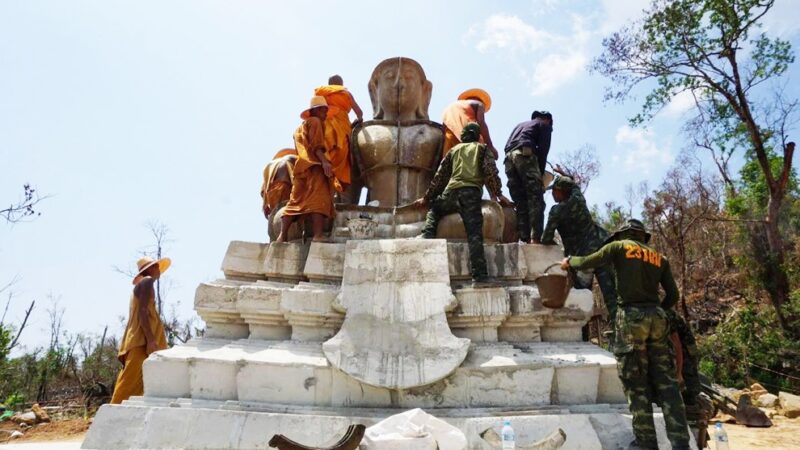
According to the official statement, the activities include the construction of roads, concrete bunkers, and permanent structures, as well as the installation of Thai national flags and religious statues. Key areas of concern include:
• Oddar Meanchey Province: Thai armed forces reportedly used heavy machinery to excavate land and build new concrete bunkers southeast of the Ta Moan Thom temple. Similar activity, including road construction, was noted in Thmar Don village, Banteay Ampil district.
• Preah Vihear Province: Significant infrastructure development is occurring at An Ses, Mom Bei, and the Ta Thav areas. This includes the clearing of land and the erection of Buddha statues by both Thai military personnel and monks at sites such as Phnom 469, Phnom 677, and Phnom 500.
• Strategic Heights: Construction of permanent structures has also been documented at Phnom 505 and near the Don Tuan temple.
Legal Standing and Sovereignty
The Cambodian Ministry emphasized that these locations fall entirely within the sovereignty of the Kingdom of Cambodia. The Ministry cited the 1:200,000 scale maps produced by the Indochina-Siam Boundary Commission, which are recognized under the Franco-Siamese Convention of 1904 and the Treaty of 1907.
“Cambodia calls on Thailand to immediately cease all activities in the aforementioned areas to avoid further unilateral actions,” the Ministry stated. “We urge the full and faithful implementation of all existing agreements to de-escalate the situation and promote mutual trust.”
Commitment to Peace
Despite the rising tensions, Cambodia reaffirmed its “unwavering commitment” to a peaceful resolution. The government maintained that border disputes must be settled through diplomatic means in accordance with international law.
The statement concluded with a firm principle: “Borders must not be changed by force.”
-
Cambodian Authorities Bust Online Scam Den in Phnom Penh; 19 Chinese Nationals Detained
PHNOM PENH – In a continuous crackdown on cross-border cybercrime, the Phnom Penh Municipal Unity Command launched a targeted raid on an online scam operation nestled within a luxury gated community in Chbar Ampov district.
The operation, which took place on March 17, 2026, resulted in the arrest of 19 Chinese nationals at a villa located in Borey Peng Huoth Boeung Snor.
The Raid and Seized Evidence
Acting under the direct orders of H.E. Khuong Sreng, Governor of Phnom Penh, and coordinated by Deputy Prosecutor Phi Sithong, law enforcement stormed House No. 14, Street M05, in Sangkat Niroth.
During the search, authorities uncovered a sophisticated digital setup designed for fraudulent activities. The seized evidence includes:
• 123 smartphones and 8 All-in-One computers.
• Multiple monitors, laptops, and central processing units (CPUs).
• 3 sets of fake Chinese police uniforms and helmets, used to impersonate law enforcement officers during video calls to intimidate victims.
Modus Operandi: Impersonation and Exploitation
Preliminary investigations suggest the syndicate was utilizing Cambodian soil as a “safe haven” to execute complex Online Scams. The group specifically targeted victims by posing as Chinese authorities, using forged documents and uniforms to build false credibility—a common tactic in “pig butchering” or extortion schemes.
The 19 suspects and the confiscated equipment have been transferred to the Phnom Penh Municipal Police Headquarters. Officials stated that the investigation is ongoing to identify the ringleaders and broader networks connected to this cell.
Zero Tolerance: The April 2026 Deadline
This high-profile bust aligns with the stringent mandate set by Prime Minister Hun Manet, who has pledged to completely eradicate technology-based crimes from Cambodia by April 2026.
The Prime Minister has repeatedly emphasized that Cambodia will not be a sanctuary for cybercriminals or transnational syndicates. Under the current administration’s policy:
• Strict Enforcement: No legal exceptions or interventions will be granted to those involved in scam operations.
• Maximum Penalties: Both individuals and entities found backing these activities will face the highest level of prosecution under Cambodian law.
As the April deadline approaches, business leaders and investors in the region see these aggressive crackdowns as a vital step in restoring Cambodia’s digital reputation and ensuring a secure environment for legitimate SME growth and foreign investment.